English
 French
 German
 Italian


Solar Financing in Nigeria: How to Install Solar Without Paying Everything Upfront (2026 Guide)
One of the biggest reasons many Nigerians delay switching to solar energy is the upfront cost. While solar systems save money long-term, the initial investment can feel expensive for many homes and businesses.
That’s why solar financing is becoming increasingly popular across Nigeria.
Today, homeowners, businesses, hotels, schools, and healthcare facilities are looking for flexible ways to install solar systems without paying the full amount immediately.
In this guide, we’ll explain:
- What solar financing means,
- How solar payment plans work,
- financing options available in Nigeria,
- advantages and risks,
- and how businesses can benefit from solar financing.
Whether you’re in Lagos, Abuja, Port Harcourt, Warri, or anywhere in Nigeria, this article will help you understand how to go solar more affordably.
What Is Solar Financing?
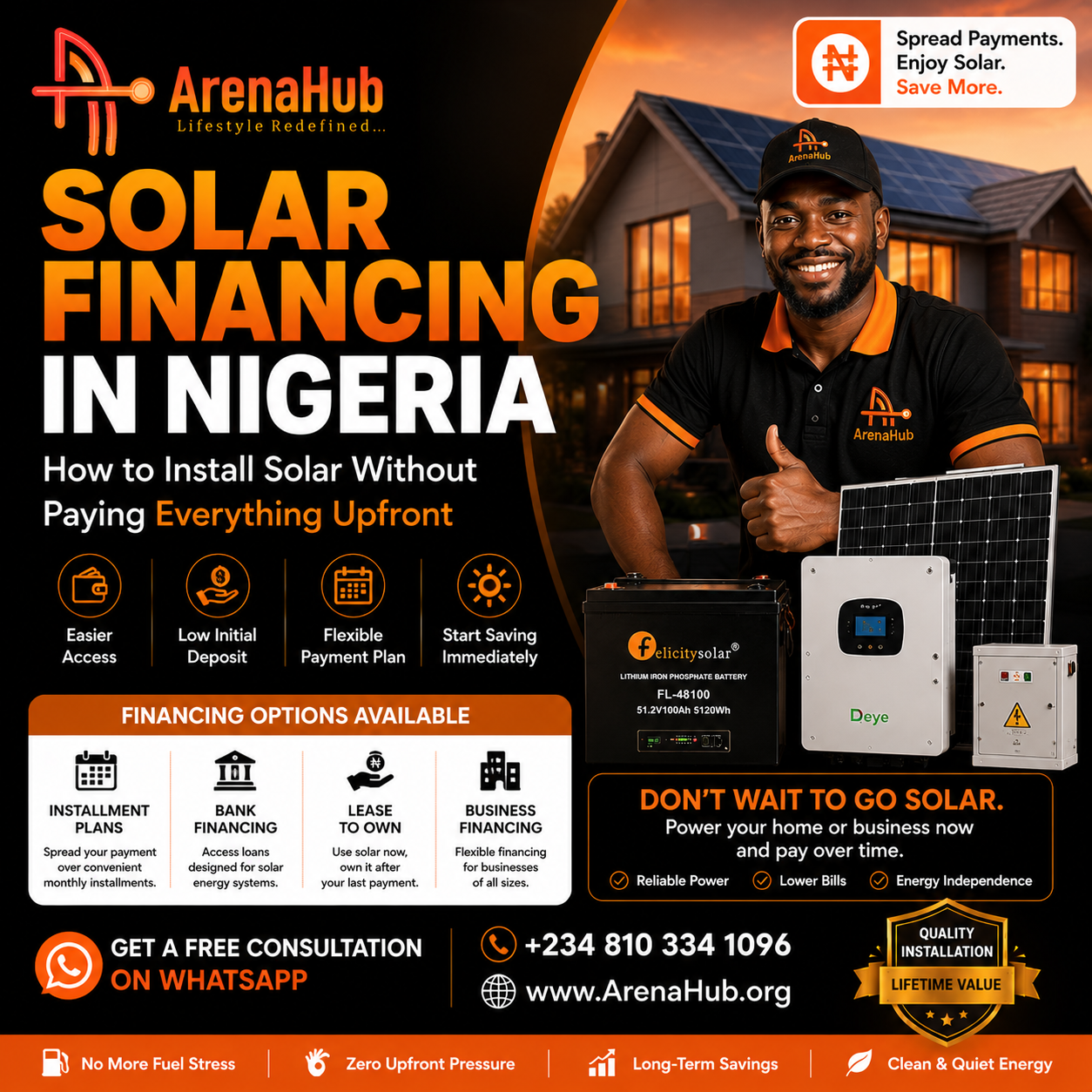
Solar financing allows customers to install solar systems and spread payments over time instead of paying the entire amount upfront.
Instead of waiting years to save enough money, financing helps homes and businesses start enjoying solar benefits immediately.
Solar financing is becoming popular because
- electricity costs are rising,
- fuel expenses continue increasing,
- And many businesses need reliable power urgently.
Why Nigerians Are Choosing Solar Financing
Many Nigerians spend huge amounts monthly on:
- diesel,
- petrol,
- generator repairs,
- and electricity bills.
Instead of continuing these recurring expenses, many people now prefer redirecting those funds toward solar payment plans.
Benefits include:
- reduced fuel dependency,
- predictable energy costs,
- and long-term savings.
How Solar Financing Works
The process usually works like this:
- Energy assessment is conducted
- A suitable solar system is recommended
- The customer makes an initial deposit
- The remaining balance is spread over the agreed periods
- The solar system is installed
- Customer makes scheduled payments
The payment structure varies depending on:
- system size,
- financing provider,
- and repayment duration.
Types of Solar Financing in Nigeria
There are several financing options available.
1. Installment Payment Plans
This is one of the most common financing methods.
Customers:
- pay a percentage upfront,
- Then spread the remaining balance over months.
Advantages
- easier entry into solar ownership,
- flexible payment structure,
- immediate installation.
Disadvantages
- The total payment may become slightly higher over time.
2. Solar Leasing
Under leasing arrangements:
- The provider owns the system.
- while the customer pays regular usage fees.
This option is common in some commercial projects.
3. Bank Loans for Solar
Some Nigerian banks now support renewable energy financing.
Businesses and homeowners may access the following:
- personal loans,
- SME financing,
- or renewable energy loans.
4. Business Financing for Commercial Solar
Businesses such as:
- hotels,
- supermarkets,
- factories,
- schools,
- and hospitals
Often, finance larger commercial solar systems over time.
This helps reduce pressure on business cash flow.
Why Businesses Prefer Solar Financing
Businesses increasingly use financing because it allows them to
- maintain working capital,
- reduce generator costs,
- improve productivity,
- and avoid large upfront expenses.
Instead of spending millions immediately, businesses can spread payments while already benefiting from solar savings.
Solar Financing vs Generator Expenses
Many Nigerians spend large amounts monthly on fuel and generator maintenance.
Here’s a comparison.
| Expense | Generator | Solar Financing |
|---|---|---|
| Fuel Cost | Continuous | Reduced |
| Maintenance | Frequent | Lower |
| Noise | Loud | Silent |
| Long-Term Savings | Low | High |
| Power Stability | Moderate | Better |
For many homes and businesses, solar financing becomes more economical in the long term.
Average Solar Installation Costs in Nigeria (2026)
Residential Systems
| Property Type | Estimated Price |
|---|---|
| Single Room | ₦900,000 – ₦1.8 Million |
| 1 Bedroom Flat | ₦1.5 Million – ₦3 Million |
| 2–3 Bedroom Flat | ₦3 Million – ₦8 Million |
Commercial Systems
| Business Type | Estimated Price |
|---|---|
| Shop | ₦2 Million – ₦5 Million |
| Hotel | ₦20 Million+ |
| Hospital | ₦30 Million+ |
Financing plans may vary depending on project size.
Benefits of Solar Financing
1. Easier Access to Solar
Customers can install systems without waiting years to save on full payment.
2. Reduced Fuel Expenses
Businesses begin saving on fuel immediately after installation.
3. Better Cash Flow
Businesses can preserve working capital for operations.
4. Stable Electricity
Reliable power improves productivity and comfort.
5. Long-Term Savings
Solar systems often save more money over time compared to generators.
Best Candidates for Solar Financing
Solar financing is ideal for the following:
- homeowners,
- business owners,
- schools,
- hotels,
- hospitals,
- offices,
- supermarkets,
- and factories.
It is especially useful for businesses with high generator expenses.
Common Mistakes to Avoid
1. Choosing Cheap Components
Low-quality systems may fail quickly and increase maintenance costs.
2. Ignoring Battery Quality
Lithium batteries are often more reliable for financed systems because of their long lifespan.
3. Working With Inexperienced Installers
Improper installation can damage expensive equipment.
4. Taking Oversized Systems
Customers should choose systems that match their actual energy needs and budget.
Why Lithium Batteries Are Popular in Financed Solar Systems
Most modern financed solar projects use lithium batteries because they
- last longer,
- require less maintenance,
- charge faster,
- and support long-term reliability.
Also Check: Solar Energy for Hospitals in Nigeria: Reliable Power for Healthcare Facilities (2026 Guide)
Lithium vs Tubular Batteries
| Feature | Lithium Battery | Tubular Battery |
|---|---|---|
| Lifespan | 8–15 Years | 3–5 Years |
| Maintenance | Low | High |
| Charging Speed | Fast | Slower |
| Performance | Excellent | Moderate |
How Solar Financing Helps Nigerian Businesses Grow
Reliable electricity helps businesses:
- reduce downtime,
- improve customer satisfaction,
- increase productivity,
- and lower operational costs.
Businesses no longer need to rely entirely on expensive fuel-powered generators.
Why Solar Financing Is Growing in Nigeria
The growing demand for financing is driven by:
- rising fuel prices,
- unstable electricity,
- inflation,
- and increasing awareness of renewable energy.
Many Nigerians now see solar as a long-term investment rather than a luxury purchase.
Is Solar Financing Worth It?
For many people, yes.
Instead of:
- spending heavily on fuel every month,
- dealing with noisy generators,
- and suffering frequent blackouts,
Solar financing allows customers to transition into stable electricity gradually.
The long-term savings often outweigh the financing costs.
Solar Financing in Nigeria
Frequently Asked Questions (FAQs)
Can I install solar without paying the full amount up front?
Yes. Financing and installment plans make this possible.
Is solar financing available for businesses?
Yes. Many commercial solar projects are financed over time.
Are financed solar systems reliable?
Yes, especially when quality components are used.
Which battery is best for financed solar systems?
Lithium batteries are generally preferred because of their durability and long lifespan.
Can financing reduce generator expenses?
Yes. Many customers reduce fuel expenses significantly after switching to solar.
Final Thoughts
Solar financing is making renewable energy more accessible for Nigerians.
Instead of delaying installation because of upfront costs, many homes and businesses are now spreading payments while already enjoying the following:
- stable electricity,
- lower fuel expenses,
- reduced maintenance,
- and long-term energy savings.
The key is choosing:
- quality components,
- experienced installers,
- and financing plans that fit your budget.
As electricity and fuel prices continue rising, solar financing is becoming one of the smartest ways to achieve energy independence in Nigeria.
ArenaHub provides premium solar solutions and flexible payment options for homes, businesses, hotels, schools, and healthcare facilities across Nigeria.
✅ Hybrid Solar Systems
✅ Lithium Battery Solutions
✅ Professional Installation
✅ Nationwide Delivery & Support
📞 WhatsApp: +2348103341096
🌐 www.ArenaHub.org
📩 Send us a message today for a free consultation.